

THE YEARNING
OF THE MAGUS
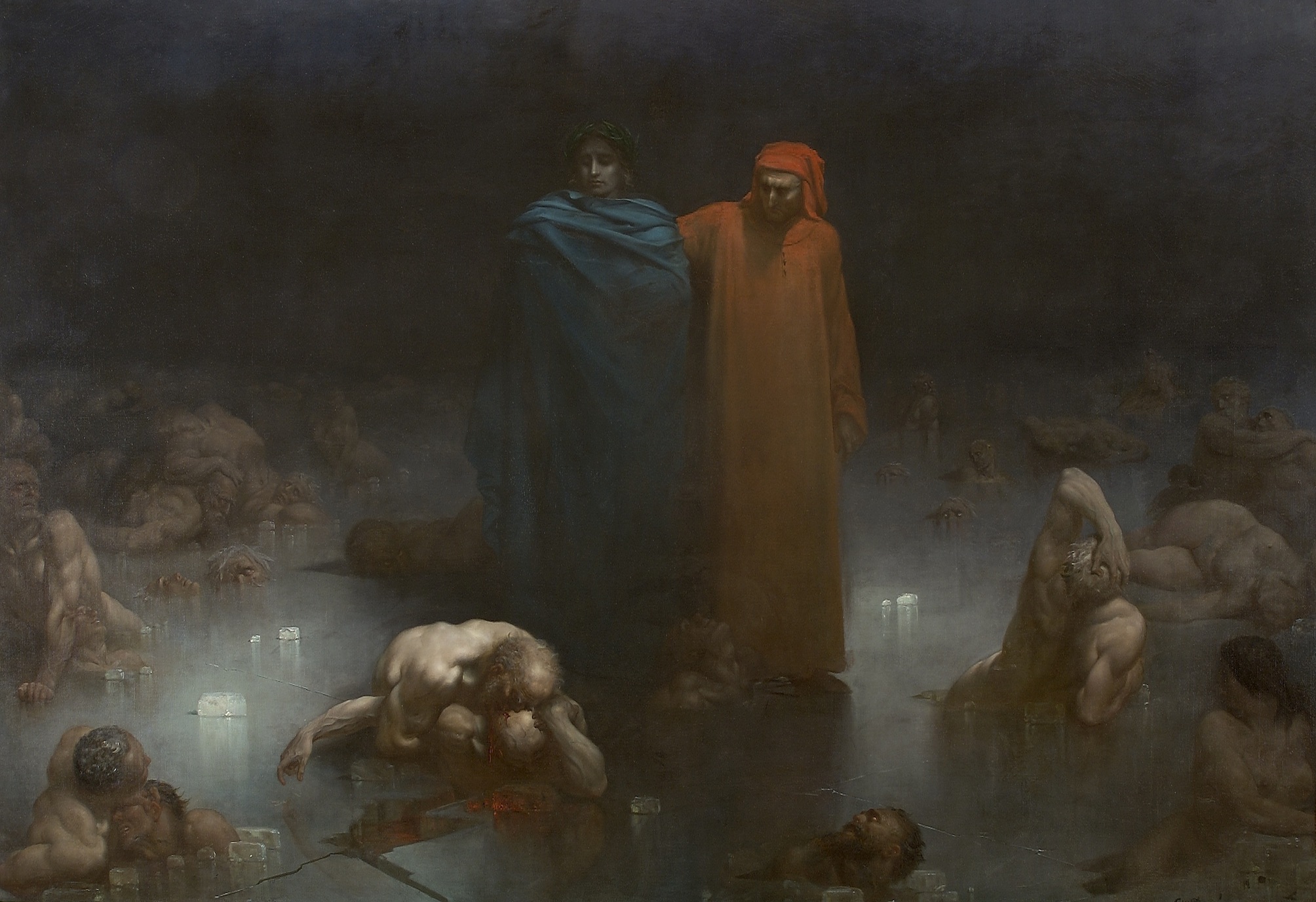
Dante and Virgil in the Ninth Circle of Hell, by Gustave Doré
How, after communing with the Eternal, can we return to this world, mingle with men, deceitful as they are? There is something that breaks, a part of the being that does not return, being trapped in the arms of the immeasurable; this is similar to the post climatic effects, after orgasm, that little death, in which we are elevated to absolute pleasure, followed by laughter full of satisfaction, to finally be struck down by a sudden drop of momentum. In the case of the mystic, such grief is not temporary, but becomes a constant affliction, in the face of which he must find calm, deal with it according to his best efforts, under fear of being consumed, leading him either to indigence or madness. Such is the yearning of the magus, the persistent nostalgia to touch the Eternal again, knowing that it is but a fleeting moment, since he must return to the desolate landscapes of the World, once colourful, that pale in comparison to what he experienced in his spiritual ecstasy.
Of course, the title of this entry can be misleading, since what I am describing is strictly speaking the path of the mystic, which will not necessarily be the same as that of the magician, depending on the current that he follows. The same can be said of the witch, although those who follow my work will know in advance my appreciation of both terms, so it is not necessary to delve into it. Precisely, due to the particular definition in which I wrap the concept of the magus in my imaginary as a practitioner, and as a writer, it must be assumed that the witch/mage is also a mystic, incessantly seeking to lose himself in the desert, or on the top of the lofty mountain, seeking in solitude the union with the transcendental and divine.
It is probably that heavy nostalgia, a peculiar sadness with dreamy nuances that is reflected in the eyes of the practitioner who has been a participant in the metaspiritual, the reason why such a lonely path is traditionally set under the rule of Saturn; the archetypal image of the planet, that of the gaunt old man with a long beard and sober clothing, becoming a template to characterize the figure of the mystic. This is not unrealistic because, in effect, the Saturnian kiss, a blessing and a curse simultaneously, is imprinted on the cheeks of the adept, to accompany him in his love for solitude and distance from the profane world, but condemning him to a melancholy for experience, over and over again, the eternal moment in which he is sacrificed on the altar of the Elder Gods, his flesh devoured and spirit inflamed, instant in which he is able to perceive the face of Truth, immeasurable divine force.
However, despite the fact that the mystic is appropriately identified with the grey-robed traveller, immortalized in the figure of the Nordic Odin/Wotan, and indeed, as Grimnir the Hooded One, we find the magus in the permanent pursue for wisdom and contact with the supernatural through an ambivalent immersion in the natural world, that of common men, and as well in abstract mythical scenarios, I cannot avoid referring in this discourse to another character, very similar in certain aspects to Wotan, but who shows the fertile hope that lurks within the sadness that imbues the mystic in his ordeal.
Al Khidr, the Green Pilgrim, is one of the figures of the mystic par excellence, having achieved such intimacy with the divine that he was sent by Allah to teach the august Musa (Moises), although the latter was already consecrated as a great sage. Al Khidr is said to roam the world, belonging to nowhere and everywhere at once, a cosmopolitan ethos that would be embraced even by philosophical schools like the Stoics; denoting his presence by a spring breeze, regardless of season, and the flash of emerald light from his robe; his blessed feet being able to make the most arid desert green and flourish. Like Wotan, he tends to wander the towns of the profane, a notion that the mystic must be such whether he finds himself in an isolated cave or amidst the bustle of the marketplace. Although in him, almost a demigod, or more like an avatar of the impulse to rise to the unknowable, that yearning, consequence of henosis, has been intermingled with a jovial delight result of the certainty of the vital triumph of nature; because the mystic, thanks to his self-sacrifice of permanently isolating himself in an internal mountain, hence his loneliness that seems to never disappear, transcends the world, and is capable, by that same substantial distance, of helping it and endowing that wasteland, caused by the fallen race of Adam, with fertility. This existential principle, which defines the life of the mystic, is synthesized in the well-known phrase, remade from the Bible: I am in the world but I am not of the world.
Dressed in green or grey, the mystic cannot exorcise Saturn from his aura, since at the same time he empowers and punishes him; like Al Khidr beheading the infant that would become the debacle of his parents; or Wotan causing scuffles and slaughter among Volsungs with the challenge of the gram/nothung sword. The reasons of both are veiled, since only they are participants in the everlasting, and from the isolation of the hermitage, cloistered in a stony peak, they have a panoramic vision forbidden to the rest of men.
In a similar spirit, the mage, turned into a mystic, endures his days with the burden of a sorrowful heart that has opened to the embrace of divinity, endowing him with wisdom, and condemning him to ostracism among the multitudes. Despite this, the permanent memory of past unions serves as a breath that drives the journey, memory of a privilege that is gladly paid for. Not infrequently Al Khidr is represented on a fish, crossing the waters, in a liminal gesture that makes us not forget that we are travellers between two worlds, unable, for the moment at least, to abandon one fully and reach the other; the fish, symbol of the Waters of Life, testimony not only of the practitioner’s mastery but also of divine favour, since unlike the philosopher’s stone it is not created but delivered. Likewise, the mystic becomes the Beloved of Divinity, or her Lover according to certain perspectives, being graced with her favour, but severely assuming the hardship of permanent exile.

