A MINIMALIST APPROACH
TO THE ARTE MAGICAL
Man is his inner self, not the material possessions he acquires; although these undoubtedly form part of the image he wishes to project to the world, sometimes consciously and other times automatically, they are ultimately transient elements that, to paraphrase Borges, are unaware of the existence of their possessor. Such materialism, where the individual is defined by how many objects he possesses, was a constant debate among the Stoics, defenders of an austere life, where wealth and fame are insubstantial and only useful if they allow one to do good, as well as to live according to natural laws.
Such enslaving attachment is not only suffered by mundane human beings, but also takes hold among practitioners of the Magical Art, albeit with its own peculiar nuances.
I must clarify that this brief essay is not a diatribe against material things. I am not an anchorite with iron-clad vows of poverty, nor do I claim to be one, nor do I wish to be. Material well-being is extremely important, as it allows us to alleviate banal and elemental concerns, allowing us to dedicate ourselves to the study of the transcendental. Money is, and this is undeniable, a supremely useful instrument that can enhance ambitions and desires of lofty nobility, provided its possessor does not allow himself to be blinded by temporal pleasures, becoming their servant. No, he must be the master of gold, to be used for relevant purposes, in our case, for the exploration of the Mysteries and personal apotheosis.
After all, someone who barely has a living, how can he have the time and inclination to embark on spiritual abstractions?
Even the monks, those who swore to renounce their possessions for theological study, were guaranteed a roof over their heads and bread, one less worry that gave them the ability to dedicate themselves to the divine. Renaissance artists, such as Verrocchio and Donatello, found in the Medici the ideal patrons, whose financial contributions made it possible for them to devote themselves without pain or hardship to their artistic works. All of this proves that, although it may sometimes be a nuisance to admit, material resources are of great importance when it comes to immersing oneself in intellectual, artistic, and spiritual fields. Certainly, I have never been the type of practitioner who rejects prosperity, declaiming about how virtuous poverty is, and inviting my readers and students to abandon worldly ambitions; I do not find, in fact, any contradiction or inherent enmity between the spiritual and material abundance, as long as the latter is at the service of the former, markedly facilitating the path of alchemical perfection and magic.
We can be practitioners of the Old Craft and prosperous individuals, a not unusual leitmotif for ancient magicians. One need only look at the PGM to get a sense of how this was a desire pursued by Ptolemaic magicians; we also find it in Arabian magic, from Shams al-Ma’arif to Ghayat al-Hakim. Perhaps the importance of trade in North Africa and the Middle East influenced this vision, from which we could learn much.
I mention all this because it’s crucial to understand that I’m not against material well-being and comfort. On the contrary, in my tradition, it’s customary to only accept a new aspirant when there’s evidence of a certain level of stability, as this will aid them in the coming trials, particularly intense in a chthonic and nocturnal current. This same aspect can be disrupted if the Powers consider their foundations to be out of alignment with the Truth. For this reason, it’s not unusual for new initiates to be individuals of a certain age, having achieved a level of self-sufficiency that’s not usually common in adolescents or lazy people.
No, this is not an essay against material goods, but rather an invitation to get rid of what is unnecessary for the practitioner, not only in their everyday life but also in their magical practice.
As a Stoic adherent, I am necessarily a minimalist, ergo, I consider that only that which is useful is imperative; for the discerning, this is clearly a not-so-veiled nod to beauty, in a distinctly Platonic sense, since what is beautiful is naturally harmonious, useful, and good; if not, it is merely a banal add-on and a chimera that simulates true beauty. The defense of “less is more” lies not only in the West within the Stoic school, but in Japan, specifically in Zen/Chan Buddhism, it has an important stronghold; In this eastern path, emerged within the Tang Dynasty in China and later adopted by the Japanese, simplicity is equivalent to freedom and rhythmic balance with the existential order, which is why an aesthetic is encouraged devoid of unnecessary ornaments and artifacts that undermine the full potential of the individual, knowing that we are mentally formed by the environment in which we live, which has a direct impact on the exercise of will, an invaluable and irreplaceable resource for the magician/sorcerer.
Harmony is, simply, the balance between the proportions of a whole, and it is what Zen and Stoic movements seek; anything that is superfluous disrupts this consonance, the equilibrium of the constituent elements, bringing confusion and disorientation. This point is extremely crucial, because when extrapolated to the individual, it reveals how the unnecessary accumulation of external elements, contrary to providing fulfillment and satisfaction, actually causes loss, subtracting the principle of equitable order from one’s internal, personal universe. Clearly, this condition is one of the most widespread contemporary ills, and it is surprising that many have not realized the reason for such levels of discontent, despite the illusory financial comfort and possessions.
In the Old Craft, this is reflected in the usual excessive accumulation of objects, artifacts, and ornaments, which serve no real purpose on the altars, not even an aesthetic one in the true sense of the term, for aesthetics must be harmonious and beautiful, and therefore useful; they are merely a trivial visual display, clearly unnecessary for communion with the Powers and the exercise of magic. Aesthetics, in fact, may be more like the extraction of something that is incompatible with the whole.
While it’s common to acquire many instruments and natural ingredients within the magical arts, in the overwhelming majority of cases, they serve little purpose, and many practitioners make their altars and homes look like antique shops. While this may be appealing to Victorian England aficionados—and I’m a bit of a connoisseur, as I am—the reality is that they aren’t necessarily magically useful, being, once again, insubstantial appendages.
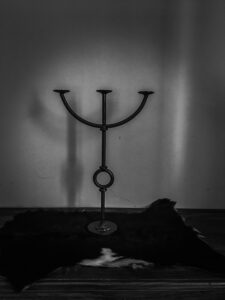
The magical altar, unlike simpler devotional altars [shrines], constitutes, on an esoteric level, the magician’s Personal Realm, being a microcosmic reflection of his universal reality, hence the importance of keeping it well cared for, since what lies there will have a direct impact on the soul and life of the individual. Overloading it will do the same, hindering the clear signaling of the Powers. Although we may be tempted to place on the altar any eye-catching object we see, we must ensure that it is something that the spiritual and/or divine forces truly need, and not just for our apparent visual satisfaction. If there is one topic I emphasize, and this my close students know very well, it is that the mind is fallible, and the magician/sorcerer must never rely absolutely on its appreciations, lest they fall into an erroneous, and inflated, perception of themselves. That is why we possess mancies and oracles, which allow us to elucidate the veracity of our notions.
While the witch/magician utilizes a variety of instruments to practice their Craft, these are essential, and it is wise to avoid accumulating others that are not fundamentally necessary, complementing, replacing, or discarding them as necessary. For over a decade, I have acquired a variety of objects for multiple purposes, but I constantly analyze whether any remain necessary to my path, discarding or, when appropriate, destroying those that are not. The practitioner would do well to remember that, while such artifacts are intimate allies in the Craft, some possessing anima and numen, and even consciousness in certain instances when consecrated as dwelling places for entities, thus preserving the more primitive animistic ethos that characterizes magic, in the end, they all prove to be temporary complements on one’s journey. It is not strange, therefore, the old belief that in the end, when the practitioner reaches the perfection of his athanor, he will not require anything else, only his body, mind, and will, to thus realize the desire of his Immortal Spirit.
Of course, this is not an invitation to dismiss objects, daggers, talismans, seals, fetishes, etc., not at all. All of them are precious companions on the hieratic path, but the practitioner must have the discernment to know when one of them is necessary and when a superfluous addition is necessary, lest their pilgrimage be slowed down by unnecessary burdens.
This extends to entities, as there comes a time when the connection that once bound us to one must end, provided there are no permanent pacts involved; it is not unusual for a spirit or deity to enter our personal sphere for a specific purpose, after which it is not required to maintain a lifelong altar to it. Minimalism in the Magical Arts, therefore, not only involves physical objects, but also spiritual relationships, as well as personal ones in the everyday social spectrum. Cutting ties with spirits or human beings, whether because they are harmful or have become incompatible for crucial reasons, is healthy for the practitioner’s well-being, as well as the effectiveness of their magic.
On a pragmatic note, I can recommend that the individual dedicated to the Old Craft, once a month, ideally during the waning phase of the Moon, in order to take advantage of its instinctive influence, first review all the objects, both profane and magical, in their life and home, getting rid of everything unnecessary. This includes items as trivial as clothing or shoes, and as significant as that extra bronze censer they’ve never used. I recommend maintaining rigorous criteria, weighing whether any artifact actually has a place, since we tend to say it does, consoling ourselves with the fact that maybe not now but possibly tomorrow, and in the end, we never use it, hoarding materials for nothing. Secondly, analyze habits and social interactions that should be preserved and those that shouldn’t. This can be a difficult exercise, as human beings often make excuses to avoid parting with things, people, or circumstances, but it will serve as a useful communion with the goddess Truth, the ultimate patron of magic.
Once a year, you should do the same, but with your spiritual relationships and the general practices of your own tradition or path; perhaps taking advantage of your own solar cycle, or in the case of initiates, the anniversary of the sacred event, to carry out a complete renewal. In this, I recommend seeking the advice of your divine guides, especially your personal Daimon [Agathos Daimon/Holy Guardian Angel] if contact and communication have already been established, to avoid making any hasty decisions that could have negative energetic consequences in the medium or long term.
Let the practitioner always be attentive to each step taken, for living automatically, without room for a panoramic view, will tend to plunge them into mirages and procrastination, realizing too late that they have hoarded elements that are burying them fruitlessly. Since the path of magic is one of transformation par excellence, it should not surprise us that the magician/sorcerer must be in constant renewal; resisting change is not only counterproductive, but alien to the very essence of the Old Craft.
Certainly, we must be like snakes, eager to shed their skin, discarding what should no longer be.

