
GENUINE ALTARS
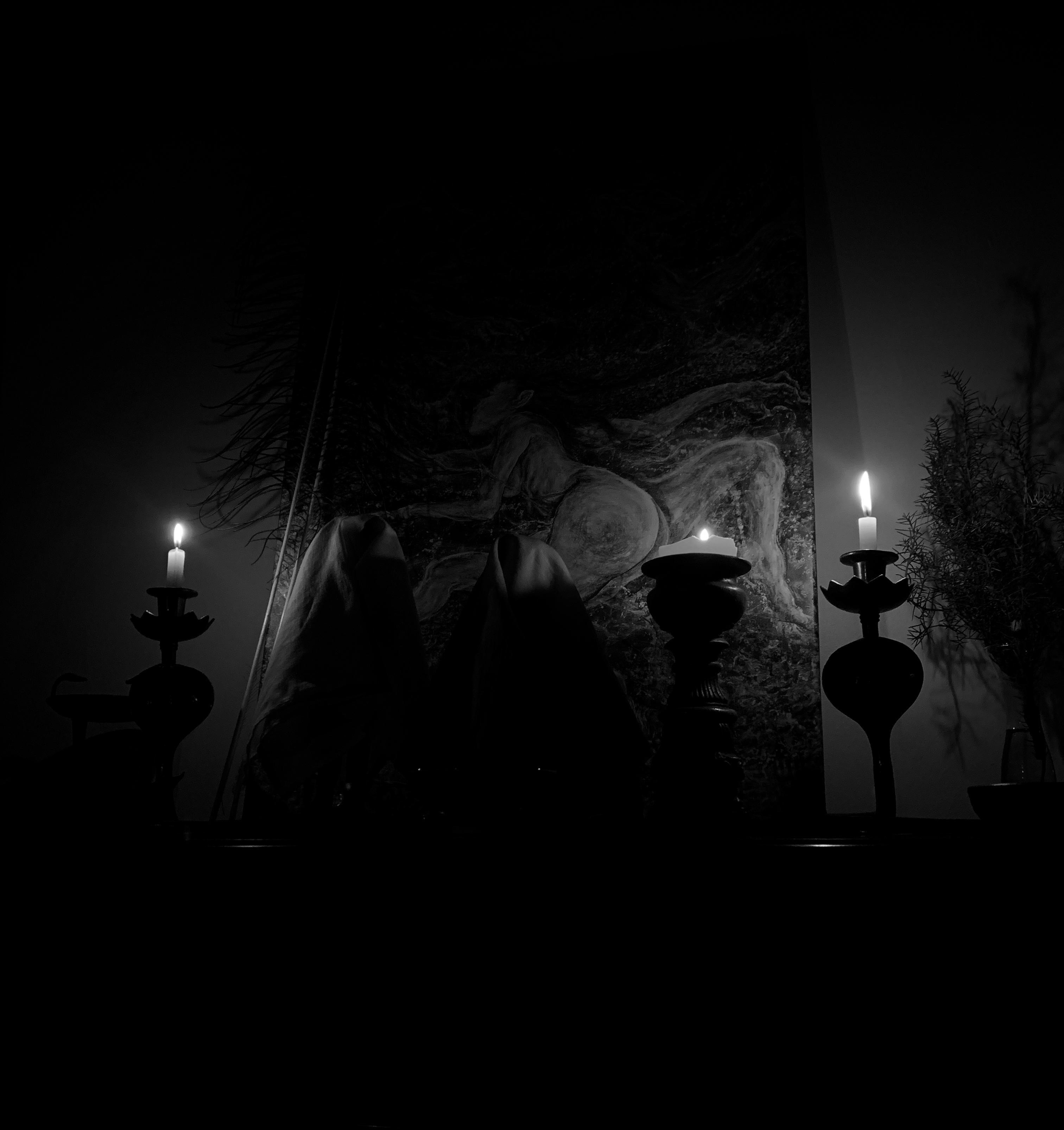
The constant reflection surrounding my altars is not what I can add, but what I can subtract and simplify; what is no longer necessary or useful, temporarily or permanently.
The altar is the external expression of the magician’s inner realm; the less there is outside, the more there is inside.
The Great Work is a constant preparation for death. Indeed, the very path of the magician, even from his earliest days, is a permanent effort toward a good death, to return to the subtle realities that serve as the genesis of his soul and, if he is wise, not return to this unbearable and noisy human disaster. Anyone who doesn’t understand this hasn’t truly begun to walk in such ways; a pity, for the opportunity is short.
Due to the intensely personal nature of altars, these being a response to the practitioner’s interaction with Otherness, and at all times I am referring to the altars that can be built by a genuine practitioner of the Arte Magical, not a mere devotee, and the confusion between facing deities and spirits as a magician or as a religious person is another matter, the modern fondness for copying trends is surprising, ignoring not only territorial particularities, but also personal requests that the same Power has over different individuals, as long as they are capable of listening to it.
I’ve seen this trend, very frequently, on social media, and even in books written by modern occultists, where altars seem to be exact copies of one another, simply changing colors, decorations, and certain singular details, but maintaining a sort of pattern that makes them easily identifiable. Patterns are important in magic; in fact, each rite or magical action leaves a pattern, a kind of etheric blueprint, and this is what makes it successful to be able to repeat them, even by those who do not see their subtle fibers, because by repeating it, they connect with that root rite, connected to the energetic pulse that feeds them, reproducing it over time. However, the altars, particularly religious altars [those that seek communion with a sui generis force] that a magician can erect, for there are many types of altars, some useful and others absolutely useless (I’m looking at you, New Age altar with quartz stones) – although I won’t go into them in this short post – are the result of an organic mix between the known correspondences of a particular entity, i.e. the symbolas and synthemata that guarantee the attraction of that specific force, and the synthesis that results from the encounter between entity and practitioner, which will bring about unique changes for the individual, by virtue of their peculiarities, character, and whatever the spiritual creature, be it god, daemon, or whatever, wishes to reveal about itself. This is evidence of the clearly personalized character that an altar can, and should, have, being non-transferable from one magician/witch to another, even among those belonging to the same tradition.
There are many reasons for such incessant altar copying, so I don’t want to be reductionist and place all the blame on widespread ignorance, although this is often the root of all evil. It’s a situation curiously prevalent in contemporary Traditional Witchcraft, a term so overused that it can no longer bear further use, and which seems to resemble the oldest prostitute in a brothel. I think, in this case, there are three main reasons:
- The mere desire to reproduce an aesthetic trend
- The need to feel part of a select community
- Ignorance of how altars work, ergo, ignorance regarding the subject at hand (I’m sorry, it’s unavoidable).
The first point is serious, as it declares the individual a spurious practitioner, who does not delve into the Arte Magical out of a genuine desire for perfection and contact with the Powers, but rather out of a tendency to satisfy a need for visibility. Worse still is the case of a practitioner who has genuinely walked the path, but for ignoble, financial, or banal reasons, has become corrupted, yielding to whatever circumstantially calls for publicity. This, unfortunately, is not only evident in the copying of aesthetic fashions at the altars, but also in the guru on duty who leads “workshops” on popular magical topics, or on controversial subjects, which are truly useless for the growth of seekers and practitioners, simply out of a desire to gain a larger audience and money. Fortunately, those who descend to this level tend to become disillusioned with magic, since the entire core of their praxis is vacuous and therefore will not produce results that lead to true progress, a guarantee of fidelity to the path; and if they have apparent success among impressionable novices, because they have used marketing well, they end up suffering ostracism from the circles of authentic magicians/sorcerers, capable of seeing beyond the sequins and the circus, in addition to an even more horrendous consequence: if they had true internal contact, they will find that such entities will withdraw, abandoning them, since they lie on infertile ground, from where they will be unable to contribute to the growth, maintenance, and real diffusion of the Hieratic Art.
“The purpose of magical traditions is to preserve the Mysteries, not to limit them.”
Secondly, we find the fruitless desire to “belong,” reproducing the current fashions. This is not due to malicious ambitions for popularity, but rather to a childish desire for identification. Human beings are gregarious; being part of “something” is inherent to our nature. However, when this identification is not organic, the product of a harmonious synchronization between those who seek the same goals, but rather an artificial assembly of a piece that doesn’t fit, we encounter a problem. Perhaps, being a little more optimistic than my usual suspicion, this distortion finds an explanation in the concept of religious community, understanding it as the uniform adoption of beliefs, along with their aesthetic expression. While this is valid from a secular perspective, it is clearly insufficient from the praxis of magic, which is our ultimate interest, since I do not write for the general public but for those interested in the faithful exploration of matters of mystical transcendence and the real practice of magic. The notion of a monolithic religious community of practitioners has no place in the Arte Magical, where, even within a single order, lodge, or conventicle, each individual practitioner is the expression of a singular universe, woven by diverse connecting threads, which give rise to empirical developments rich in a diversity of colours, shades, and forms; this translates, simply, into the fact that the very gods/spirits that govern a tradition will have, not unusually, and despite the objectivity of the entity’s existence, since they are not the product of the mere psychological projection of the practitioner, an anachronistic Crowleyan vision, requirements, methods, and ways, chiselled from the magician’s abilities, shortcomings, and propensities. If this occurs even in fraternities located in the same territory, it is to be expected that it will be reproduced, with greater force, within traditions of broad international reach, or at least it should be so in theory, if the Order is to be alive and connected to the energetic engine that feeds its esoteric current. If the fraternity adheres to inflexible dogmas and immutable contact structures—understanding, of course, that certain pillars must remain unchanged, as they relate to the foundation of the Order’s etheric temple—it will be destined, at the very least, to stasis; after all, the purpose of magical traditions is to preserve the Mysteries, not to limit them. If such a need for individual freedom in contact, and ways of establishing and expressing it, is present within well-established initiatory traditions, the same, and more, is expected from a freelance practitioner, not attached to a specific group.
To this we must add the often overlooked issue of territory, which is crucial to the harmonious development of the magician’s/witch’s praxis. Some traditions can be exported to regions outside their homeland, others simply cannot, being necessarily anchored to their homeland, making it futile to attempt to reproduce them elsewhere. This is a topic that must be evaluated objectively and rationally by the practitioner; passions or tastes are irrelevant in this matter, and self-deception is an underlying danger.I have seen how pseudo practitioners, and I use the compositional element on the basis that a genuine practitioner should be able to realize, believe they are summoning a certain entity, and reproducing ceremonies of a tradition, without anything presenting itself and not even a hint of real energy, or that which should be forming, being threaded together. I’m not saying that it’s impossible for the gods of one territory to move to another, after all they are deities – expressions, or interfaces, of natural and cosmic forces – in theory they can be everywhere, and such was the vision of Neoplatonists like Iamblichus, but there are protocol techniques that must be taken into account, and sometimes it’s impossible to move them to another place, for reasons beyond the scope of this entry, which is already longer than I initially wanted. When it is possible to transport them to a new region, it is important to consider the changes this may have on interaction with the Power, new windows/channels of contact, and their impact on the new territory, where they may overlap with a similar local divine form; in the past, this has led to syncretism of deities. All of this will have obvious consequences for the altar that will be used as a focal point.
Returning to the popular, yet maligned, Traditional Witchcraft, we find the celebrated dissemination of the Cornish Bucca tradition, thanks to the books of Gemma Gary, a respected British author of occult and folk magic. Today, this typically English movement has been reproduced, not necessarily in an initiatory manner, not only in the United States but also in places as far away as Brazil. I joked recently that G. Gary should charge for the copyright on her altars, which seem to reproduce as quickly as the hare, the patron beast of witchcraft, by the way. Indeed, seeing such copying, sometimes so notorious as to border on vulgar plagiarism, is what prompted this discussion. The Bucca is a unique expression of the folkloric Devil figure, a master of witchcraft, particular to that region of southwest England. Its export, even to the United States, whose cultural and racial ties with Albion do not obviate the fact that it is a completely different territory, has always seemed to me a delicate matter, requiring objective analysis by the responsible practitioner, concerning its feasibility. Certainly, this contemporary frenzy for the figure of the Master Witch, where once singular expressions are replaced by a common aesthetic line, e.g., the goat skull with the candle between its horns, gives rise to questions that may be uncomfortable for some, such as the contradictory universality of a god who is fundamentally a living manifestation of the territory. Internationalization on such a scale is not as dissimilar as trying to bring the cult of Kadi a Mpemba, the Congolese “devil,” to Norway, blindly reproducing his ethos in a place, and reality, completely different from his natural environment. Whether it’s possible is not the issue at hand, as the methods can be found; it easiness , with a few exceptions involving completely non-transferable territorial entities, is the crux of the matter.
All of this requires a high level of discernment, one of a mage’s most important virtues, along with dispassionate restraint. Although much comes into play, from a magical perspective, in these processes of adaptation and worship, so that, to my regret, I cannot cover everything in this succinct digital journal entry, I want to focus on the defining personalized, tailor-made characteristic of interacting with the gods, daemons, and various intangible creatures. Although we speak of objective realities, and therefore possessing “universal” symbols, their expression in the individual’s life depends on their multiple idiosyncratic, personal, and worldly facets, which will inevitably influence the peculiarities that shape the altar, the magician’s realm, making it genuinely unique and effective, as well as the construction of the singular cult itself. This reminds me of the theurgic considerations regarding the personal daimon, where although they are ruled by a great lord of the daimons, using a common type of invocation, the daimon upon manifesting, giving its name and identity, will reveal the distinctive cult it requires, totally rooted in the soul nature of the practitioner who has called it, being distinguishable from the venerations of another of its congeners. This is not entirely different with the gods, when the contact is real, for example: a deity associated with the colour red might suggest to the magician of choleric mood that he limit the use of the hue in his altar and cult, or that he employ a muted range of the same colour, or another absolutely different one that nullifies certain influences, all with the aim of protecting him; another beneficent entity, of a Saturnine nature, with all that this implies, might prescribe to a practitioner of depressive inclinations some special prerogatives to prevent his energies from leading him into an uncomfortable emotional state. If the practitioner closes himself off to this, in order to imitate well-known aesthetic preconfigurations, for the reasons explained above, he will be curtailing the benefits of genuine contact, and may even end up with an altar void of any authentic numen, or be replaced by astral parasites, who will take advantage of the unwary.
Ultimately, there is the issue of the lack of understanding of the functionality and typology of altars, a complex topic that I prefer to avoid in a public entry such as this one, and which constitutes an entire chapter in my private training, due to its neuralgic role in the path of the magician, one that serves to differentiate him from the mere religious devotee. It is enough to glimpse that altars are temporal batteries, even when such temporality can extend to the entire physical life of the individual or lodge/coven/group, with two clear projections, one external physical and the other internal etheric. If this second side of the coin does not exist, the one that serves as an astral blueprint, the altar derives only in a mere artistic stage, a dramatic visual expression, solely intended to satisfy the individual’s ego. The mere copying of aesthetic tendencies usually produces this result, since what is created is merely a profane temple [the better, the worse, a reservoir of parasitic larvae], not a vehicle to a higher spiritual reality. Ultimately, if the altar does not originate in organic and direct contact, that intimate and extremely personal relationship between Power and magician/sorcerer, with implications of mutual synergistic benefit, which will have aesthetic manifestations that may seem superficial to the uninitiated, but which conceal changes, declinations, and vade mecums of their own, then it is better not to have one at all, until the path, and its allies, truthfully demand it.

