It is crucial to understand, with the greatest possible solidity, at least as much as is externally transmissible, since true understanding of such matters is only attainable through empirical evidence, the nature of what we poetically call the Arte Magical, for it represents a unique current that cannot, and should not, be confused with the mere practice of plain sorcery and/or basic operative magick; it constitutes, in fact, a path of supreme spiritual realization, seeking to transcend the limitations of the material plane to achieve full enlightenment for the practitioner.
May this succinct essay shed some light on the matter.
While the Arte Magical has been considered by some distinguished practitioners as a brother of that conceptual umbrella called witchcraft, sorcery, or enchantment, and even seen as synonyms, in your author's experience the comparison is, unfortunately, insufficient, at least when it comes to fully exploring its background and genesis. Magick, as it is currently understood in the West, tends to be reduced to its merely operative and immediate character, with special emphasis on folk magic, spells, and grimoires, being virtually devoid of all true mysticism; the Arte Magical, for its part, under the esoteric canon that imbues its most extensive imagery, conceptually surpasses such details, traveling not only back to classical and late antiquity, with its mystery cults, of which the medieval Witch Sabbath is a later iteration, but even deeper into the mountains of Anatolia, the sands of the eastern deserts, and even the banks of the Nile. Although for many years I considered witchcraft and the Arte Magical to be one and the same, the passage of time, interaction with the Powers, as well as a greater understanding of the Mysteries, opened up new possibilities that led to a rethinking of such questions, for the sake of that irrepressible search for Truth. Although Traditional Witchcraft, circumscribed as it is, is part of the Arte Magical, understood as that initiatic Royal Art that has taken on various expressions, it is not its entirety, but is encompassed by it, embraced by its timeless mantle.
The Arte Magical is a magical and mystical approach to a mysterious spirituality that naturally unites the stellar and chthonic, the theurgic and goetic, a higher manifestation of magick, transcending its merely operative side, that focused on resolving superficial and mundane needs. This veiled Arte Hieraticus [mod. Hieratic Art], as it is also known to denote its priestly and arcane essence, is the persuasion of bonds, tying or releasing elements, shifting them to the realm of the sacred and subtle, with the aim of producing a change of state, sometimes minor and other times, when it reach to its roots, to the transmutation of the practitioner who, like the serpent, seeks to become a dragon, thus uniting with the Eternal. Therefore, the Arte Magical cannot be called a tradition per se, but rather a way of dealing with subtle realities, with its own ethos, composed of an intimate vision of interaction with spirits, from which formal traditions can emerge, that is, teaching structures subordinated to a mythopoetic imagery, protocol, and singular methods of magical, spiritual, and mystical exercise, linked by a lineage, both etheric and sanguine.
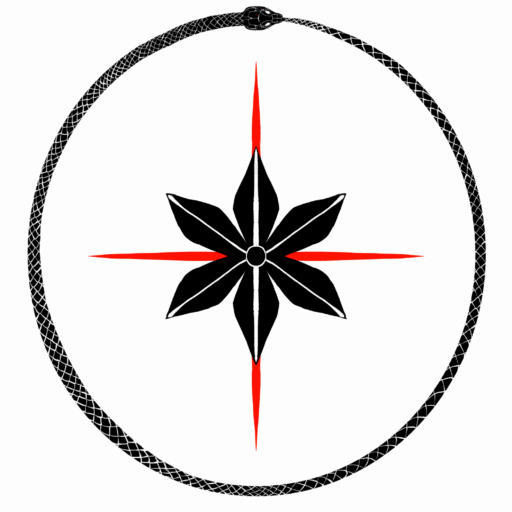
The Serpent, indeed, is the great patron of such arcana, a symbol par excellence not only of transformation, expressed in its constant shedding of skin, but of the magical path itself; in truth, the atavistic reptile, according to the imagery that surrounds our Arte, is on a journey toward ultimate exaltation, where it will metamorphose its form, revealing its primordial manifestation as the dragon, the supreme, quintessential effigy of the Mysteries and Magic. It is not surprising that the practitioner is equated with the serpent in his own pilgrimage and ordeal, yearning for final liberation, awakening the pure clarity of his mind and soul. Thus, we will discover the ophidian mysteries as one of the cornerstones of the Arte Magical, encrypting the ethos of alchemical transformation of our customs, vehemently directed toward the apotheosis and spiritual fulfilment of the practitioner. Indeed, one of the oldest symbols used in occultism is the Ouroboros, the snake that devours its own tail, originated in Egyptian magic and extended to the later esoteric and alchemical tradition, conceived as one of the primordial manifestations of the magic circle (Skinner 2013), the protective temenos par excellence of the magician.
However, it would be wrong to assume that the importance of the serpent would determine that the core of the work in the Arte is exclusively chthonic, ignoring the stellar aspect of it; to radically opt for one or the other would be a mistake, born of a lack of understanding of the full potential of both. The dragon, in effect, is of dual nature, for like a great serpent [remember that the root of the word Dragon is found in the ancient Greek δράκων (Drakōn), originally used to designate vipers in a general way] it slithers in the depths of the earth, and with its wings rises to the top of the starry vault; constantly traveling between zenith and nadir. Perhaps it is also necessary to recall that the stars/planets are seen most clearly on the darkest night, reaffirming that the nocturnal nature of the Arte transits in harmony with its stellar and cosmic facet.
That remembered English necromancer, Jake Stratton Kent, elegantly summarized such a dual perspective in his delimitation of the archaic Goeteia, an ancient Hellenic tradition that stands, without a doubt, as one of the primitive sources of the Arte Magical, the following appreciation being useful for us:
These two worlds, the centres of two opposed worldviews, can be termed the celestial and chthonic worlds. These are not the limits of the worldviews concerned, but their centres. That is to say, while Revealed Religion [Theurgy] has as its base the celestial or even super-celestial realm, it does not exclude considerations of other regions, such as Earth, Hell and the physical universe in general. Similarly, while natural religion [Goeteia] has the Earth and the Underworld at its heart, this does not prevent it dealing with gods of thunder or the Sun and Moon. (Geosophia vol. I, p. X) [brackets are mine].
Since this Hieratic Art is a way of approaching Otherness, through techniques, technology, and structural principles, which have been maintained, under certain mutations, over the centuries, and even millennia, from which traditions with particular idiosyncrasies and mythopoetic symbology emanate, it is not unusual to find individual practitioners, as well as groups, whose focus is fundamentally on nocturnal/chthonic work, while others direct their efforts towards the empyrean/planetary; such a dichotomy reaffirms the living and fluid nature that characterizes this path, when it is exercised genuinely.
Constituting itself as the Arte Hieraticus, that is, sacred and priestly, these customs cannot be bottled up in dogmatic limitations, for they seek Truth, and She is found in multiple facets. Therefore, this sui generis path transcends the trivial considerations that emasculate modern occultism into dichotomies of Right-Hand and Left-Hand Paths; its transcendental, and truly disruptive pulse, cannot be pigeonholed into one or the other. Just as operative witchcraft must know how to heal and sicken in equal measure, the refined Arte Magical, endowed with intimate eschatological elucubrations concerning the ultimate ends of Being, equally embraces the ascetic and heretical, the sanctioned and the reprobated, in a constant dance that simultaneously transforms the practitioner into sculptor and iconoclast.
Contrary to magick of an operative typology, which is focused on resolving temporal problems, within the Arte Magical lies an underlying interest on the practitioner's acerbated improvement, encompassing the three constituent areas of his/her extensive manifestation: body, mind, and spirit; this is done knowing that each of them synchronizes with the next, in an indissoluble chain, like gears in the individual's great athanor. In this, the Arte lies near the ethos of certain Eastern traditions, in which the maintenance of the carnal vehicle is imperative for the ultimate liberation, serving, in turn, as a laboratory and first temple, the most important one no doubt, knowing the energetic thresholds that lie within, those that must be opened and transmuted, through simmering and distillation, to achieve apotheosis.
Naturally, this holistic transformative characteristic, places this Hieratic Art within the realm of mysticism, uniting it at a distance, saving differences, with Greek mystery schools such as Orphism and Eleusis; Hebrew, as Kabbalah and Hasidism; Eastern, such as Sufism; Indian and Tibetan esoteric and tantric forms; and even expressions of European Christian ecstatic mysticism, particularly Spanish and German. This, of course, clearly differentiates itself from merely operative magic, placing the search for direct contact with the divine at the centre of the practitioner's life, as well as the acceptance of the subsequent changes this brings to his inner world, which are directly invited by the individual in a genuine metaphysical yearning. That a universal thread unites these mystical schools is evident in their similar conclusions and practices, aimed at removing any obstacle that prevents union with the divine. For example, advanced forms of Tantrism advocate contemplating the entire world as the mandala of the god who governs the flow; in a similar vein, within Sufism, we find the constant exercise of Dhikr, the remembrance of the Beloved (God) in all things and individuals, in an unstoppable recollection of the divine presence; both contemplative exercises resonate with methods of the Arte Magical, which seek to visualize universal nature as the altar/temple of the tutelary god, or of the ruler of the singular tradition, both in its beneficial and repulsive reflections.
Regarding denominations, labels that are actually useless, but which can be useful terminologies to differentiate the adherent of the Arte from other magical and/or mystical schools, there will be some who prefer the term mage/magician, others simply practitioner, or the more popular witch.
From Persia we have received to this day the word "mage", derived from the proto-Iranian magû (pl. magûs), converted into Greek mágos (pl. magoi), then into Latin magus (pl. magi), finally arriving to our English/Spanish tongue, and other vernacular languages of similar tone.
What we understand today as magic, and which has been defined in various ways, was conceived in its most archaic Iranian origin as the science of the magûs, who belonged to a priestly caste -a striking resemblance to the Egyptian tradition of lector priests, seen as guardians of the closed knowledge of Heka- which eventually converted to Zoroastrianism. Thanks to the great impression these magûs made on Greek writers, the word ended up being used to generally define those who performed enchantments, spells, and any action that sought to summon spirits or bring about changes in the world by means considered by laymen to be supernatural. During the classical period, mágos became synonymous with goes [gr. γόης, pl. γόητες], a profession initially characterized by sui generis connotations; both the magoi, goetes, and theurgists, later unified in the eyes of the Christians of Late Antiquity, were initiators of Mystery Schools, requiring formal induction, or the mystical adoption by a god, and so they stand as appropriate terms for a practitioner of the Arte Magical, although with nuances, if we want to be strict in their definition, which escape this short introductory essay.
Finally, regarding the term “witch”, a few clarifications are important. While the word witch can refer to individuals inclined toward operative magick, or to the very pragmatic sorcery, it also conceals within its Anglo-Saxon etymological origins a mystical truth close to, and related to, the distinguished Hieratic Art.
It has been consistently claimed that the root of Witch can be found directly in the Old English Wican (to bend, curve) and Witan (to know), a claim championed by a number of practitioners, and whose main proponent was Gerald Gardner, who once considered Wica to be synonymous with Witchcraft; however, American professor Jeffrey Burton Russell in his A History of Witchcraft: Sorcerers, Heretics, & Pagans (1980) dismisses these assumptions and proposes that the true and ultimate origin of Witch can be found in the Proto-Indo-European word Weik, whose obscure meaning brings it closer to “sacred” and “holy”, a word generally related to magic and religion.
Likewise, The American Heritage Dictionary of Indo-European Roots (2000) goes further in its definition and connects it to the later Old French Guile (cunning, deceit), a very interesting connection if we think of the role of the witch as “Man/Woman of Cunning”; as well as with the Old English Wigle (divination). From the archaic root Weik also derives the Old German Wikk, which, in turn, definitively produces Old English Wicca and Wicce (male and female sorcerer respectively); from this Wicca came the Middle English Witche, which consequently gave us the modern Witch. The first-mentioned Wican is also a late derivation of the Proto-Indo-European Weik, related, according to Professor Russell, to Old Saxon Wikan, Old High German Wichan, and Old Norse Vikja, each meaning to bend or turn.
The term Witch therefore comes, in its historical linguistic journey, from “something sacred, holy, religious”, and although witchcraft is in its purest and most brutal form a practice, and cannot be considered a religion because it does not have a specific mythopoetry to channel it, it does have a relationship, already expanded and refined properly as the Arte Magical, with the meaning contained in the popular etymological origin given by Lactantius (303-311 AD) for the word religion, i.e. religare, defining it as to bind again, this making a reference to the reunion of man with the divine; such matter is directly linked to the ability of the witch to be a bridge between both worlds, imbuing him/her with a sacred aura, thus erecting him, with every right, into a mystic.
This sum of meanings allows to strengthen the transcendental perspective of the practitioner of the Royal Art, placing him/her above the simple sorcerer, conjurer, and seer; thus constituting himself/herself as a man/woman who works the sacred, and is in turn sacred; possessor of wisdom and cunning; initiator of Mysteries; capable of reversing evil, or being its origin; acting as a link between spirits and the world of men; in an epic pilgrimage for his full spiritual realization, where he/she leaves behind his human garb and his intrinsic divine nature is revealed, returning to his monarchical place among the Elder Gods.
Under this elevated and apotheotic vision we will frame the personal requirements and weltanschauung that a true practitioner of the Hieratic Art must have, surpassing those of the simple operative sorcerer/witch, cloistered in inferior and trivial ambitions.
We find ourselves faced with a sui generis mystical line of thought, philosophy, criteria, discourse, and action; a peculiar way of believing, acting, and relating to the spiritual path and its ambiguous inhabitants; deeply rooted in a sense of belonging that seems to resurface in an atavistic manner, responding to a primitive calling, in which its genuine adherents seem to "resume" a task that was left on hiatus before the end of a previous carnal iteration, thus following a kind of ethereal lineage, which concatenates its members in the nebulosity of what has been controversially called the Ardent Lineage, which markedly differentiates them from the mere prestidigitator and banal conjurers. Thus, while hereditary lineages may exist, the leitmotif of their ancestry seems to lie in a metempsychosis of continuous resurgences, where each one seeks to complete a task of immeasurable importance, for themselves and others.
From this perspective, it is impossible not to see in the initiate of the Arte Magical a mystic dedicated to such an arduous transformative pilgrimage. Within the more customary traditions, it is common among sworn brothers to use the appellation Journeyman, whose imprint makes it impossible not to evoke the Persian dervish, or the itinerant Hellenistic goes, the former inclined toward the empyrean, the latter to the chthonic; while our Journeyman, that prince in exile, who with tireless impetus seeks to return to his former domain, resides sporadically in various kingdoms, his head among the stars, his feet entwined with the abyssal roots.
May each footprint be an initiation.